Published September 7, 2026
Forecasts for AI-agent shopping in 2030 range from $385B to $1T
McKinsey, Bain and Morgan Stanley each put a number on how much US retail revenue AI agents will handle by 2030. The top of each range runs from $385 billion to $1 trillion. Why they differ, what they agree on, and the one thing every forecast assumes about your product data.
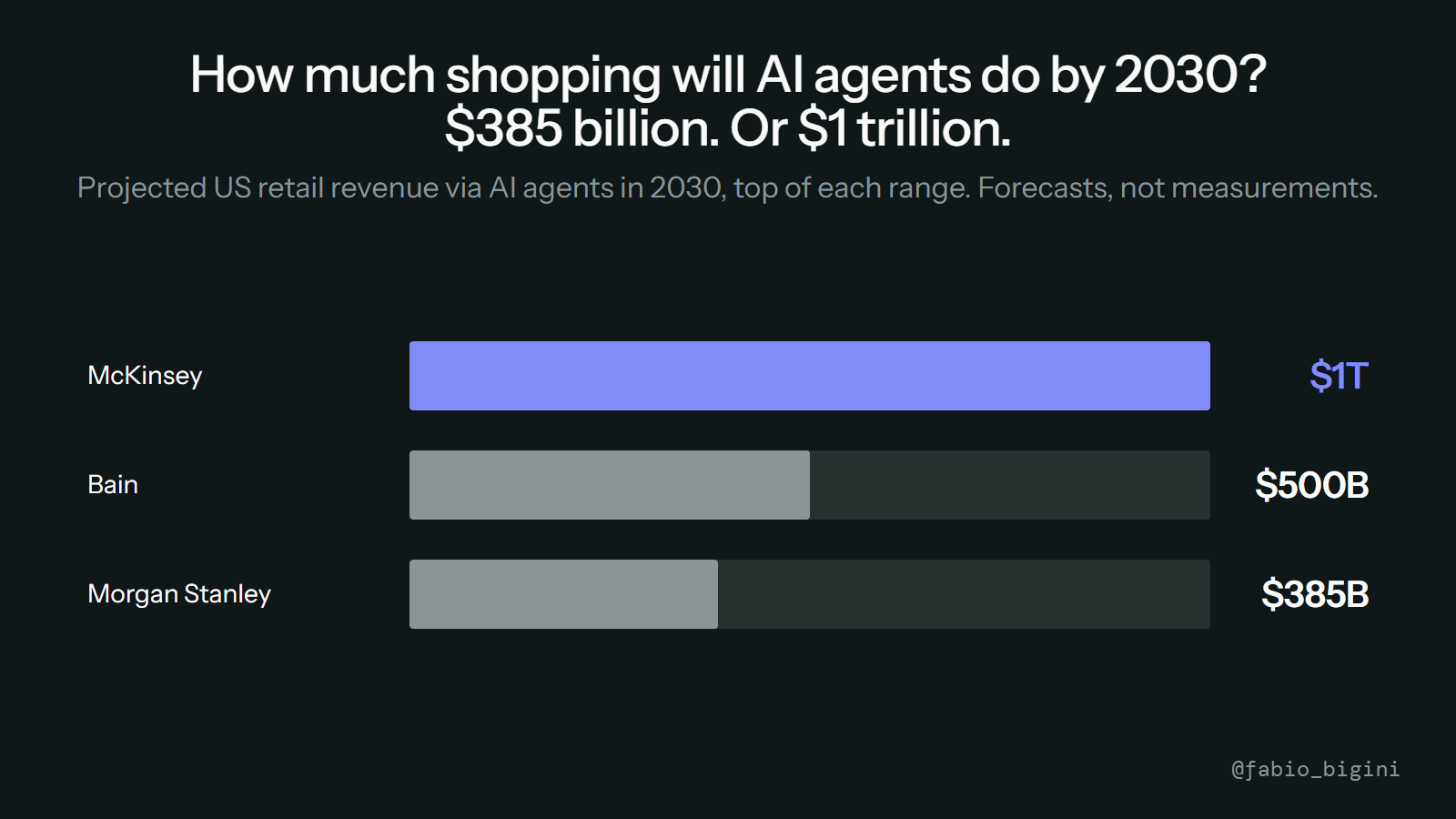
Three firms have published a forecast for the same thing: how much US retail revenue an AI agent will handle on a shopper's behalf by 2030. The top of each range:
| Firm | Top of range, US, 2030 | Full range |
|---|---|---|
| McKinsey | $1 trillion | up to $1T in US retail, $3T to $5T globally |
| Bain & Company | $500 billion | $300B to $500B |
| Morgan Stanley | $385 billion | $190B to $385B, about 10% to 20% of online retail |
Sources: McKinsey via Digital Commerce 360, Bain, Morgan Stanley.
These are forecasts, not measurements. Treat them accordingly. But it is worth knowing why they differ, because the difference is the useful part.
Why the numbers are so far apart
They are not counting the same thing.
Morgan Stanley counts purchases an agent completes. A shopper tells an assistant what they want, the agent chooses and pays. That is the narrowest definition, and it gives the smallest number: $190B to $385B, which they translate into 10% to 20% of US online retail.
Bain counts purchases an agent influences or completes. Its $300B to $500B includes cases where the agent does the comparison and the shopper clicks the last button.
McKinsey counts "orchestrated" revenue. Any sale where an agent did meaningful work in the journey: discovery, comparison, reorder, or checkout. That is the broadest definition and it gives $1 trillion in the US and $3 to $5 trillion worldwide.
So the spread is mostly about where you draw the line between "the agent helped" and "the agent bought". On the narrow definition, one dollar in ten of US online retail goes through an agent in 2030. On the broad one, the agent touches most of it.
What they agree on
Three things, and these matter more than the exact figure.
The direction. Nobody is forecasting zero, or flat. Every firm that has looked at this expects a share of retail that does not exist today to exist in four years.
The mechanism. In all three models, the agent does the comparison. It reads product data from several sellers, matches it against what the shopper asked for, and picks. The human sees the result, not the shortlist.
The timing. The infrastructure for the narrow case shipped in 2025 and 2026: OpenAI's checkout inside ChatGPT, Google's agent payments protocol, Stripe and Shopify's agent-facing commerce layers. The forecasts are about adoption, not about whether it is possible.
The assumption underneath every forecast
Each of these numbers assumes that when an agent compares products, your product can be compared. That means the facts a buyer decides on are available to the agent as data: the price, the specification the shopper asked about, what makes this one different from the next.
Today, on the shops we audit, that is often not true. The facts are in a photo, a PDF, a size chart, or in the shop owner's head. An agent reading that page gets a name and a price and moves on to a page that tells it more. The forecasts count the revenue that flows to the sellers whose pages could be read.
That is what makes the number worth acting on before 2030. The comparison is already happening today, at small scale, every time someone asks an assistant which product to buy. Ask the assistant the question your customers ask, and see whether it names you. The free check on our home page does that for one question, with a live search.