Published September 7, 2026
How ChatGPT picks a product for someone: five steps, and what it read along the way
We asked ChatGPT which espresso beans to buy in the US under $25 and watched what it did. It rewrote the question, fetched a handful of pages, compared them and answered with sources. Every page it read was a review blog; not one was a shop. What the five steps are, and what that means for anyone who sells online.
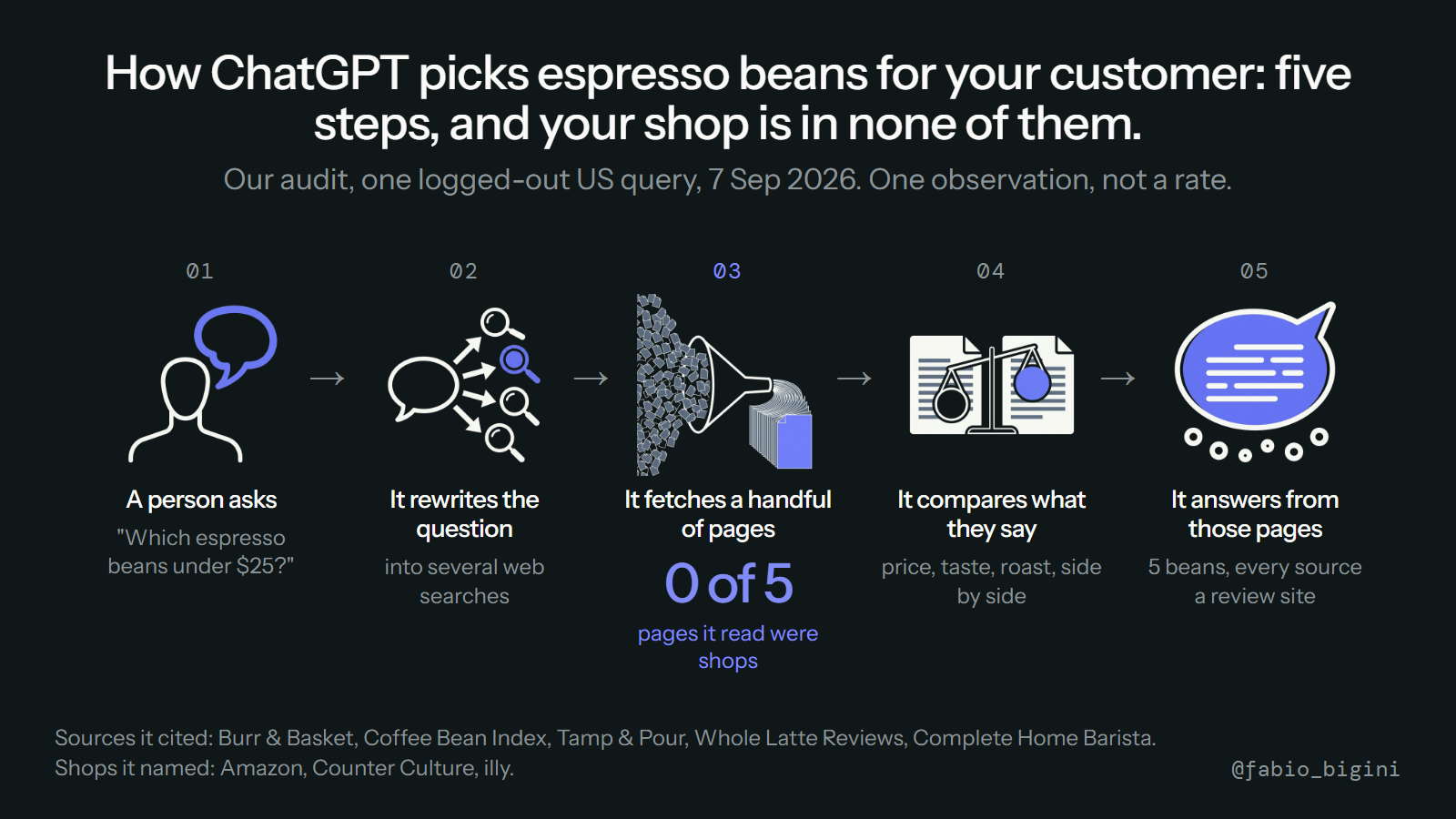
When someone asks an AI assistant which product to buy, the answer looks like it came from nowhere: a short list, a line of reasoning, a few links. It didn't. Behind it is a fixed sequence of steps, and knowing them changes how you read the answer.
Here is the sequence, with one real example we ran on 7 September 2026: a logged-out ChatGPT session, asked "Which espresso beans should I buy in the US, under $25 a bag? Give me a short numbered top 5 with the brand and the online shop to buy from."
Step 1: a person asks
The question is plain language and, like most buying questions, it carries two constraints (the country, the budget) and one request (five, with a shop). Nothing is looked up yet.
Step 2: the question is rewritten into searches
The assistant does not search for the sentence you typed. It turns it into several web searches, typically three to six, each phrased the way a search engine likes: "best espresso beans under $25", "espresso beans US review 2026", and so on. This is why an answer can include things you never mentioned and miss things you did: the searches, not your words, decide what gets found.
Step 3: a handful of pages is fetched
From those searches it opens a small number of pages, usually five to ten, and reads them. Not the whole web, not the first hundred results: a handful. The pages it reads are the entire universe of facts the answer can contain.
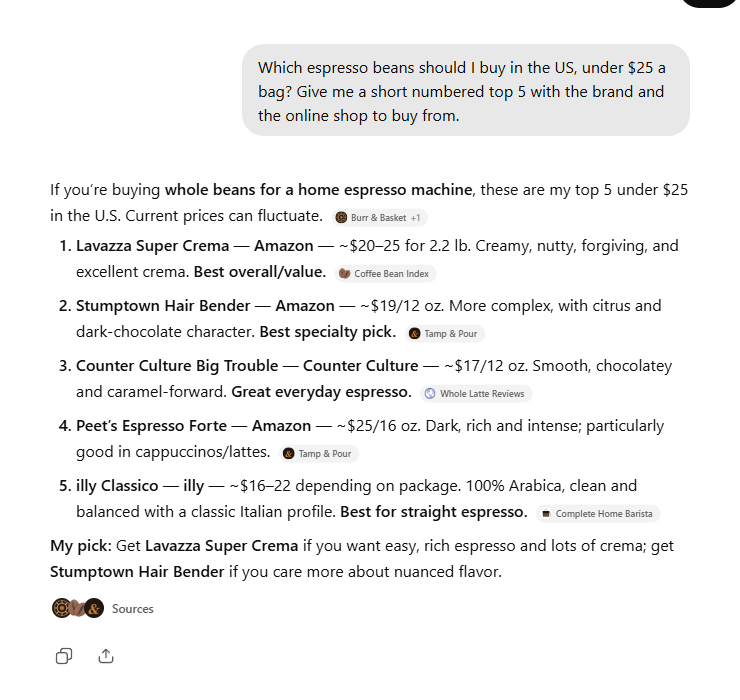
In our run, the pages it read were Coffee Bean Index, Tamp & Pour (twice), Whole Latte Reviews, Complete Home Barista and Burr & Basket. Five sites, six citations. All of them review blogs. Zero shops. (Screenshot)
Step 4: the pages are compared
Now it lines up what those pages say: price, roast, taste notes, who each bean is for. Where a page states a fact as text, that fact is usable. Where a page has the fact in a photo, a PDF or a chart image, it is not there for the comparison at all. The comparison is only as good as the text on the handful of pages.
Step 5: it answers from those pages
The answer named five beans (Lavazza Super Crema, Stumptown Hair Bender, Counter Culture Big Trouble, Peet's Espresso Forte, illy Classico) and, for each, a place to buy: Amazon three times, Counter Culture and illy directly. It named shops it had never read. The shops got in because the review blogs mentioned them.
What this means
One observation is not a rate; a different question or a different day reads different pages. But the mechanism is the same every time, and three things follow from it.
The review sites are the gatekeepers. For a buying question, the assistant reads the pages that already compare products in that category. If a category has two or three review blogs that everyone links to, those are the pages that decide the answer. Being on them matters more than any keyword.
Shops get named second-hand. A shop appears in the answer when the pages that were read mention it. That is a different game from search ranking: it is about being the place a reviewer points to, and about having a product page that states its facts plainly when the assistant does open it.
The facts have to be text. Step 4 compares text. Origin, roast, price, the thing a buyer decides on: if it lives in an image, it is absent from the comparison, however good the product.
The simple check for any category: ask the assistant the question your customers ask, and look at the citations under the answer, not just the brands in it. The citations are the pages that were read. That is where the answer was made.