Published September 8, 2026
3 in 4 pages an AI cites were updated in the last year
Seer Interactive traced 47,097 citations from ChatGPT, Gemini and Perplexity back to 7,683 pages and checked their dates. 75% had been updated within a year, 88% within two, but only 42% had been published within a year. What 'updated' means to a crawler, why an old page kept current beats a new one, and what that says about a product catalogue. With the study's limits stated.
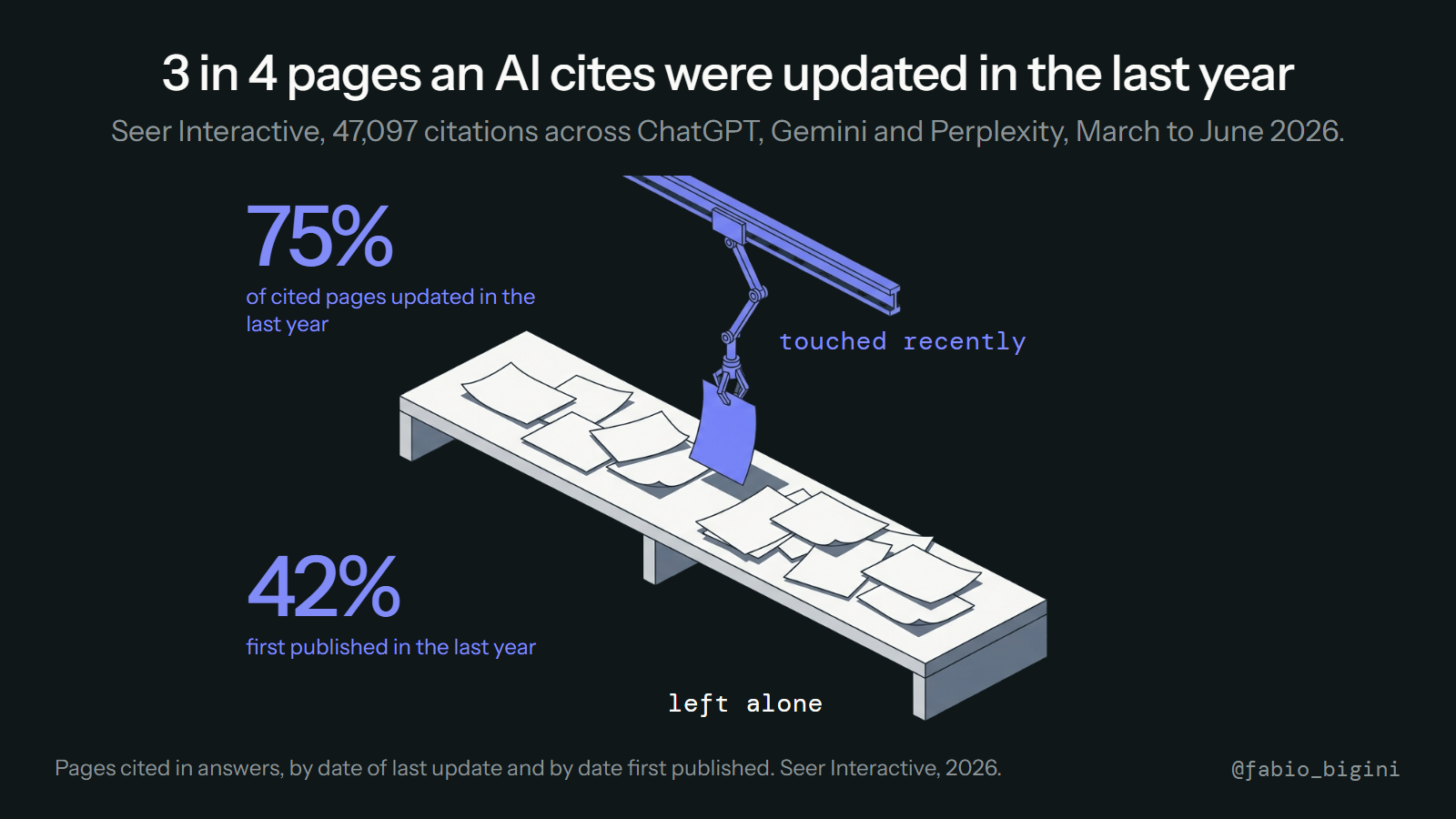
If an AI assistant cites a page, how old is that page? Seer Interactive asked the question the direct way. Between March and June 2026 they collected the pages that ChatGPT, Gemini and Perplexity cited when answering non-branded questions in four industries, kept the ones cited three or more times, and looked up when each was published and when it was last changed. That gave them 7,683 pages carrying 47,097 citations. (Seer Interactive, Content Recency's Impact on AI Visibility in 2026)
Three quarters of those pages had been updated within the last year. Fewer than half had been published within it.
The numbers
| Share of cited pages | |
|---|---|
| Updated within the last year | 75% |
| Updated within the last two years | 88% |
| First published within the last year | 42% |
By assistant, the share of cited pages updated within a year was 78% for Gemini, 73% for ChatGPT and 65% for Perplexity. The pages that were cited consistently across all four months of the study were a little older on average (68% updated within a year, median age about six months) than the pages that spiked in a single month (86%). Steady citation goes to pages that are maintained; bursts go to pages that are new.
The gap between 75% and 42% is the finding. The AI is not citing new pages. It is citing pages that were touched recently, and most of those are old pages someone kept current.
What "updated" means to a crawler
A crawler does not know that you rewrote a paragraph. It knows three things, in roughly this order of trust.
The content changed. When a page is fetched again and its text differs from the last copy, the page is treated as live. Changing a price, adding a review, fixing a specification, rewriting a section: all of these count. Changing the copyright year in the footer does not, and search engines have long since learned to ignore it.
The page says when it changed. The dateModified field in a page's structured data, and the Last-Modified header the server sends, are what a crawler reads as the official date. Many shop platforms set these correctly; many set them to the time the page was last rendered, which makes every page look updated every day and therefore none of them.
The site links to it as if it matters. A page that sits three clicks deep, off the menu, unlinked from anything current, reads as archived even if its text is fresh. A page linked from the homepage and from other recently changed pages reads as part of the living site.
Any of the three on its own is a weak signal. All three together are what "updated in the last year" looks like from outside.
What the study does not say
It is worth being precise here, because the number invites a lazy conclusion. The study counts pages that were cited and reports how old they were. It does not show that updating a page causes it to be cited. Pages that get maintained are also, usually, the pages a company cares about, links to, and has written well; recency travels with those.
The sample is also narrow: four brands, in retail energy, vacation rentals and commercial banking. It is a serious count, 47,097 citations is a lot, but it is a count of what three assistants cited for four companies over four months, not a law of the web. Treat 75% as a strong prior, not a target.
With those limits stated, the direction is consistent with everything else measured this year: assistants favour pages that look alive.
What it says about a product catalogue
Most shops have exactly the page structure this study describes. A catalogue of product pages, most of them published once, some years ago, and touched only when the price changes. The ones that get cited, if the study holds, will be the ones that show signs of life.
Three things follow.
- Retire or redirect what is dead. Last year's model still online at last year's price, with its own page and its own date, is not just clutter. It is the page a model may read instead of the current one. We have watched an assistant quote a shop's 2025 clearance page as the current price while the 2026 model sat one click away. Redirect it, mark it superseded, or take it down.
- Make real updates and let them show. When the price, stock, specifications or model year change, change the page, and make sure the structured data's
dateModifiedmoves with it. If your platform stamps every page with today's date on every render, that is a setting to fix, because it makes the signal worthless. - Keep the pages that matter linked from the pages that change. The homepage, the category page, a "what's new" section: anything that changes often should link to the products you want read, so the crawler meets them on its way through the living part of the site.
The question on the card is the honest test: when did you last update your best-selling product page? Not re-render it. Change something a buyer would notice, and a crawler would too.