Published September 6, 2026
Your customers ask an AI what to buy. Here is what it says about you.
Why we built Vedigree, what we found when we asked ChatGPT the questions real buyers ask, and why the fix is product data rather than marketing.
Vedigree launched on 5 September 2026. This post is the reasoning behind it, with the evidence we had when we started.
What changed
For twenty years, being found meant ranking on a page of ten blue links. A buyer typed a query, scanned the results, and clicked. Every tactic in search marketing was built for that click.
That is no longer where a growing share of buying decisions start. People now ask an assistant. Which magnesium supplement should I buy? Which rain jacket for cycling? Which roaster for espresso beans? The assistant reads what it can find, compares, and answers with a shortlist. Often it names a shop to buy from, too.
Two things follow from that, and both are measured rather than predicted.
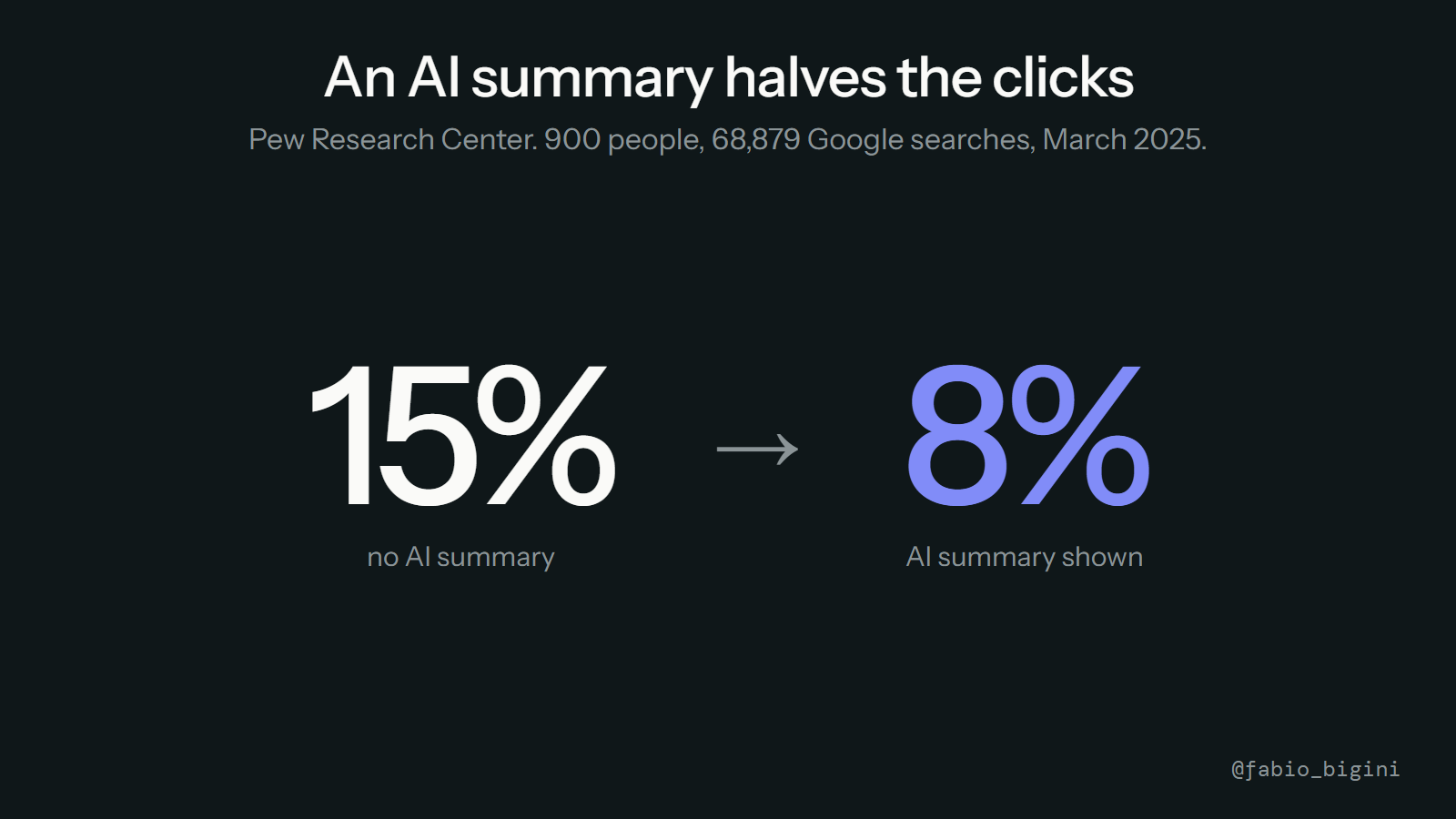
First, the answer replaces the click. In March 2025 the Pew Research Center put a browsing tracker on 900 US adults for a month, covering 68,879 Google searches. When a search returned an ordinary results page, 15% of visits produced a click on a link. When it returned an AI summary, 8% did. Clicks on a source inside the summary happened 1% of the time. Being cited is no longer being visited. (Pew Research Center)
Second, the visitors who do arrive from an assistant are worth more. Adobe Analytics, which measures over a trillion visits to US retail sites, reports AI-referred traffic to retailers up 393% year on year in the first quarter of 2026, and converting 42% better than traffic from other sources. A year earlier those visitors converted worse. They now arrive with the comparison already done. (Adobe)
The share is still small: well under 1% of retail visits. The growth rate and the conversion rate are what matter, because they say where the next customer is coming from.
What we found when we asked
Before writing a line of code we asked ChatGPT, logged out, the questions real Dutch buyers ask. Three supplement categories on 5 September, then coffee and cycling jackets on the 6th. Every answer is a dated screenshot.
- In all three supplement categories the same brand came first. The reason the answer gave was never price and never brand recognition. It was that this brand states extract ratio, active compound percentage, fruiting body versus mycelium, and independent lab testing as plain text on its product pages. The brands that lost have that information too, in a photo or a PDF.
- For espresso beans the answer named five brands and a Dutch webshop for each. Four of the five shops were independent roasters. For coffee beans for a bean-to-cup machine, all five answers were Italian supermarket brands sold through large webshops: not one Dutch roaster.
- For a cycling rain jacket, five global brands, sold through two chains. Not one independent shop.
- The answers cite review sites and comparison blogs far more often than the shops themselves.
- The lists move. A brand that sat third on a Thursday was absent on the Friday.
What Vedigree does
We run the buying questions your customers ask, across ChatGPT, Perplexity, Google AI Overviews, Claude and Gemini, and show you the answer: who is named, which shop the sale goes to, and what the answer says it compared on.
Then we do the part nobody else does. We write the facts a model compares on into your product data, in the form it actually reads, and we keep doing it as the answers move. Not a dashboard that reports the problem. The fix, maintained.
The free check on the home page is the first step of that, on one question, once. It takes about half a minute and runs a real live search.
Why product data, not marketing
A model cannot recommend what it cannot read. Every answer we captured selected on stated facts: numbers, certifications, origins, limits. Those facts already exist inside most businesses. They sit in a photo, a packaging shot, a spec PDF, a pricing page that says "contact us". Moving them into plain, structured text on the page is unglamorous work, and it is the work that decides the answer.
That is also why we started with small and mid-sized businesses in the Netherlands. They have the facts, they have the products, and they are the ones being left out of answers that name a chain or a supermarket brand instead.
If you run a shop, a service business or a software product and want to know what an assistant says about you today, run the check. It is free, and the screenshot is yours either way.