Published September 9, 2026
Ask in French and 16% of what the AI cites is French. Ask in English: 1.4%
Weglot put the same 400 questions to four AI systems in five countries, once in English and once in the local language, across more than 16,000 answers. The language of the question changed which pages got cited by more than ten times. What that means for a site that exists in one language, which pages to translate first, and what the study does not say.
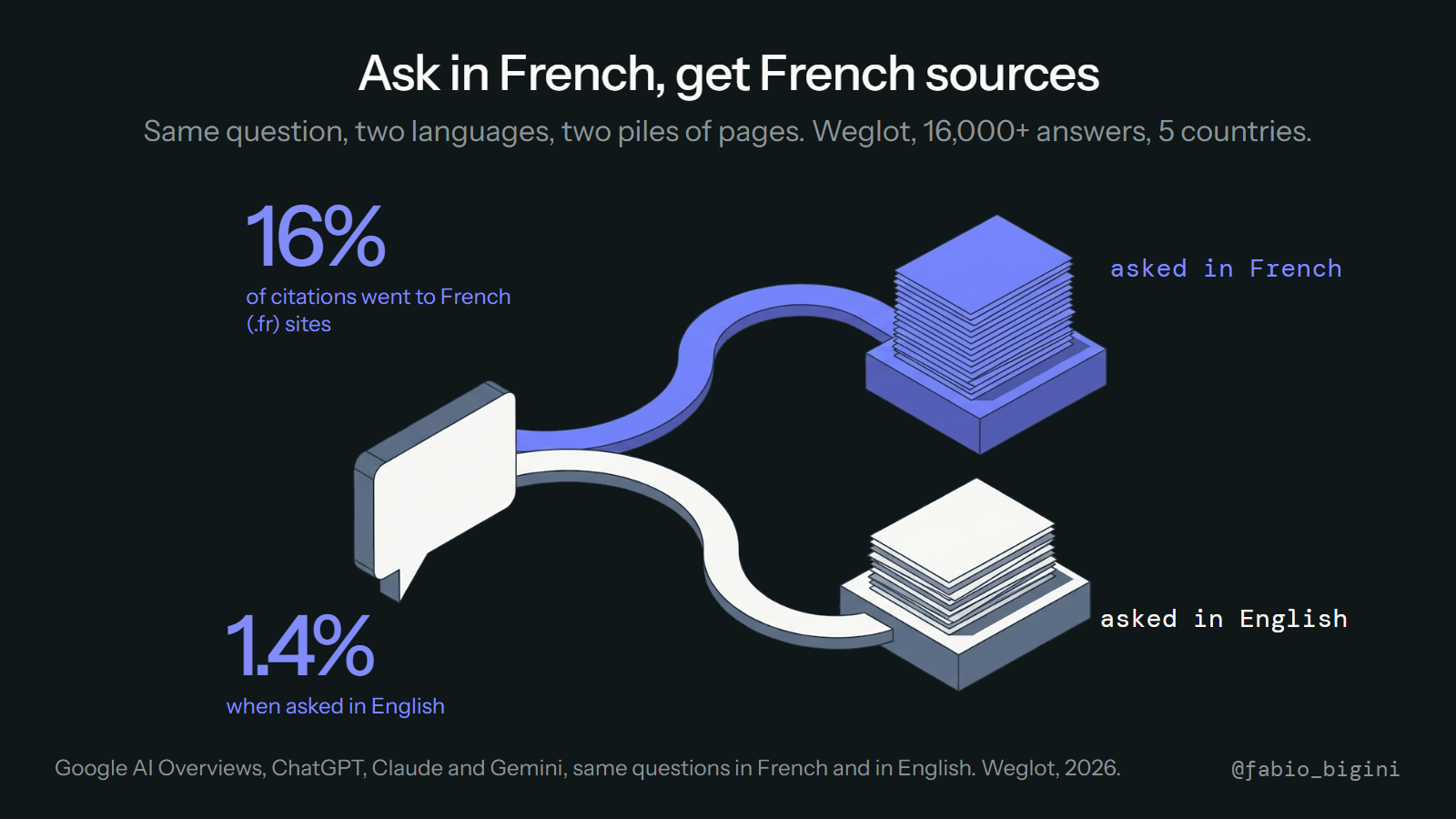
Weglot ran the same 400 questions through four AI systems in five countries, once in English and once in the local language, and counted where the citations went. In France, French-language questions sent 16% of citations to .fr domains. The same questions asked in English sent 1.4%. (Weglot, How AI Search Engines Cite Sources by Language and Country)
More than a tenfold difference, produced by nothing except the language the question was typed in.
The same pattern in every market tested
| Market | Asked in the local language | Asked in English |
|---|---|---|
| France, .fr domains | 16% | 1.4% |
| Japan, .jp domains | 26% | about 1% |
| Spain, .es domains | 7% | 1.7% |
Spain is the interesting one to read twice. Only 7% of citations went to .es domains, but 26% went to Spanish-language sources, because a lot of Spanish-language content lives on .com addresses. The domain suffix is a rough proxy; the language of the page is the real variable.
The method behind these numbers: 400 questions across five topic categories and three levels of specificity, put to GPT 5.5, Claude Haiku 4.5, Gemini Flash 3.5 and Google AI Overviews, in France, Spain, Argentina, Japan and the United States, each market queried once in English and once in its own language. More than 16,000 answers in total.
Why the language of the question changes the reading list
An AI answer to a question it cannot answer from memory is assembled, not recalled. The system writes one or more search queries, gets results, opens some of them, and writes from what it read. Every step in that chain inherits the language of the original question.
The search queries it invents are in the language you asked in. The search engine returns results matched to that language and, usually, to the country implied by it. The pages it then opens are therefore mostly pages written in that language. By the time the model composes an answer, its reading list has already been filtered by language twice, and it never saw your English page as a candidate.
This is why the effect is so large. It is not that the model prefers French sources when spoken to in French. It is that it never retrieved anything else.
If your site exists in one language
The uncomfortable version of this finding: a company with an English-only site is close to invisible to a buyer who asks in French, German or Dutch, no matter how good that English page is. The page is not competing and losing. It is not in the pool.
The reverse is just as true and easier to miss. A brand can be strong in one language and absent in another, and nothing in its own analytics will say so. Traffic from the English-speaking market looks healthy. The German buyer who asked in German got a shortlist of German suppliers and never arrived, so there is no visit to count and no bounce to investigate. Absence leaves no trace.
What to do about it
Translate the pages that answer buying questions first. Not the about page, not the blog. The pages that state what a product or service is, what it costs, what is included, how long it takes and where it ships. Those are the pages an AI opens when it needs to confirm a fact before naming you, and they are the ones a buyer's question maps onto.
A machine translation of the facts beats no page at all. The instinct is to wait until there is budget for a proper localisation. In the meantime the page does not exist in that language, which is the worst of the available states. A correctly translated specification, price and delivery time on a real URL is retrievable today; polish it later.
Give each language its own URL, and declare it. One URL per language, hreflang between them, the language declared in the page itself. A translation that only appears after a browser-side language switch, on the same URL, is a translation the crawler and the model may never see.
Check the market you think you are in. Ask three buying questions in each language you sell in and read who gets named. That is a twenty-minute test and it usually settles the argument about whether translation is worth it.
What this study does not say
It is a citation study, not a traffic study. It counts which pages an AI cited, not how many people clicked, and not how much business followed. A citation is evidence you were in the reading list, which is the necessary first step, not proof of a sale.
It also measures pages, not brands. A French buyer's answer citing 16% .fr domains does not tell you whether your company was named in the text of that answer, only which sites the answer was built from. Those two things are related but not the same, and the second one is what we measure per company.
Five countries, four AI systems, one point in time. The direction is consistent enough across every market tested to be worth acting on, and the exact percentages will move.
The question on the card is still the right first one: which language do your customers ask in, and is there a page in it?