Published September 9, 2026
Perplexity cites 19 pages per answer. Claude cites fewer than 4
Orbit Media logged 13,184 citations across 1,765 answers from ChatGPT, Claude, Gemini and Perplexity. The four tools read wildly different amounts, prefer different kinds of source, and agree with each other only 1.7% of the time. What that means for getting your pages read.
Andy Crestodina at Orbit Media has been running the same set of prompts through four AI tools and logging every source each one cites. As of 23 August 2026 the count stood at "13,184 citations and 1,765 answers", from 72 prompts across three B2B brands. (Orbit Media, LLM Citation Study)
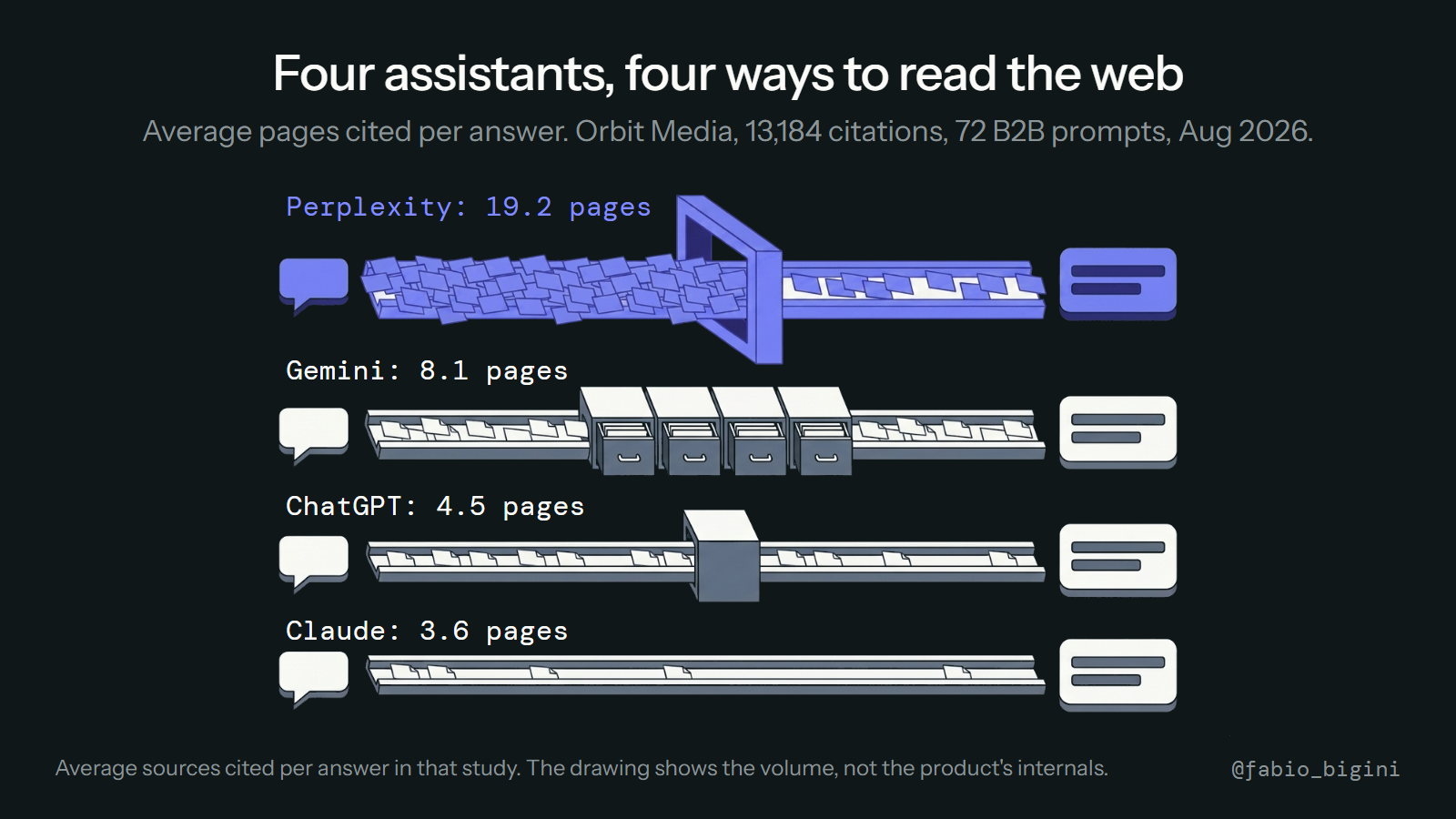
The first thing the data shows is how differently these tools read. Average sources cited per answer: Perplexity 19.2, Gemini 8.1, ChatGPT 4.5, Claude 3.6. Asked the same question, one tool consults five times as many pages as another.
Reading width is not a detail
It is tempting to treat this as trivia about product design. It is not, because the number of pages a tool opens changes your odds of being one of them.
If an assistant cites four sources for a question in your category, there are four slots and they will go to the most obviously authoritative pages it found. If another cites nineteen, the tail is long enough that a smaller, more specific page can get in. The same site can be invisible in one tool and present in another purely because of how many doors are open.
That also explains a common and confusing experience: a company checks ChatGPT, does not appear, checks Perplexity, appears, and concludes the tools disagree about its quality. They do not. One of them simply read further down the list.
They read different kinds of thing, too
The study's breakdown by source type is where it becomes useful for deciding what to actually do.
Perplexity leans on LinkedIn, YouTube and Reddit, with 374, 248 and 232 citations respectively in the dataset. Gemini leans on Reddit and listicle roundups. ChatGPT skews toward primary sources: official documentation, arXiv papers, vendors' own pricing and help pages. Claude prefers review sites and curated listicles, with the review platform Clutch as its single most-cited third-party domain.
There is one striking absence. Across hundreds of answers, Claude never cited Reddit once. For these B2B questions, Reddit was 0% of Claude's citations, 0% of ChatGPT's, 3% of Perplexity's and 1% of Gemini's. Community discussion, which dominates citation counts in consumer categories, barely registers here.
The practical read: the advice "go and get talked about on Reddit" is category-specific advice, not a law. For a B2B service, being in a credible roundup, having documentation a model can quote, and being listed on a review platform are each closer to the mechanism for at least one major tool.
The four tools barely overlap
The finding that reframes everything else: across the same questions, the four models agreed on citing the same domain only 1.7% of the time.
That means there is no single list of "the pages AI cites". There are four largely separate reading lists, built by four different retrieval systems with four different preferences, and a page that satisfies one may be structurally invisible to another. Optimising for one tool and assuming the rest follow is a mistake the data does not support.
It also means a visibility check against one assistant tells you about that assistant. If your buyers use ChatGPT and you measured Perplexity, you measured someone else's market.
What to do with this
Three things follow, in order of effort.
Find out which tool your buyers actually use, then measure that one first. In business categories that is still most often ChatGPT, which is also the narrowest reader of the four, so it is the hardest and most valuable slot to hold.
Give the primary-source readers something to quote. ChatGPT's preference for documentation, pricing pages and help content is a preference for pages that state facts plainly and keep them current. A specification page with real numbers in text beats a brochure page about excellence, for exactly the reason a model can quote one and not the other.
Be present where the wider readers look. For the tools that consult fifteen or twenty pages, presence on the roundups, comparison pages and review platforms of your category is the difference between being in the tail and being absent. Those pages are also the ones you cannot write yourself, which is why this takes longer than fixing your own site.
The limits
Seventy-two prompts across three B2B brands is a narrow sample, and the author says so; it is a running study, not a census. The specific domain counts will move as the tools change their retrieval. What is unlikely to move soon is the shape: these systems read different amounts, prefer different kinds of source, and rarely agree with each other.
The question on the card was which of the four you use most. The more useful one is which your customers use, and whether you have ever checked that tool specifically.