Published September 6, 2026
Google's AI answers take 58% of your site's clicks. Or none at all.
Four studies measured what AI answers do to clicks in 2025. They do not agree, and one finds the opposite sign. What each one measured, and what to do with a number nobody has settled.
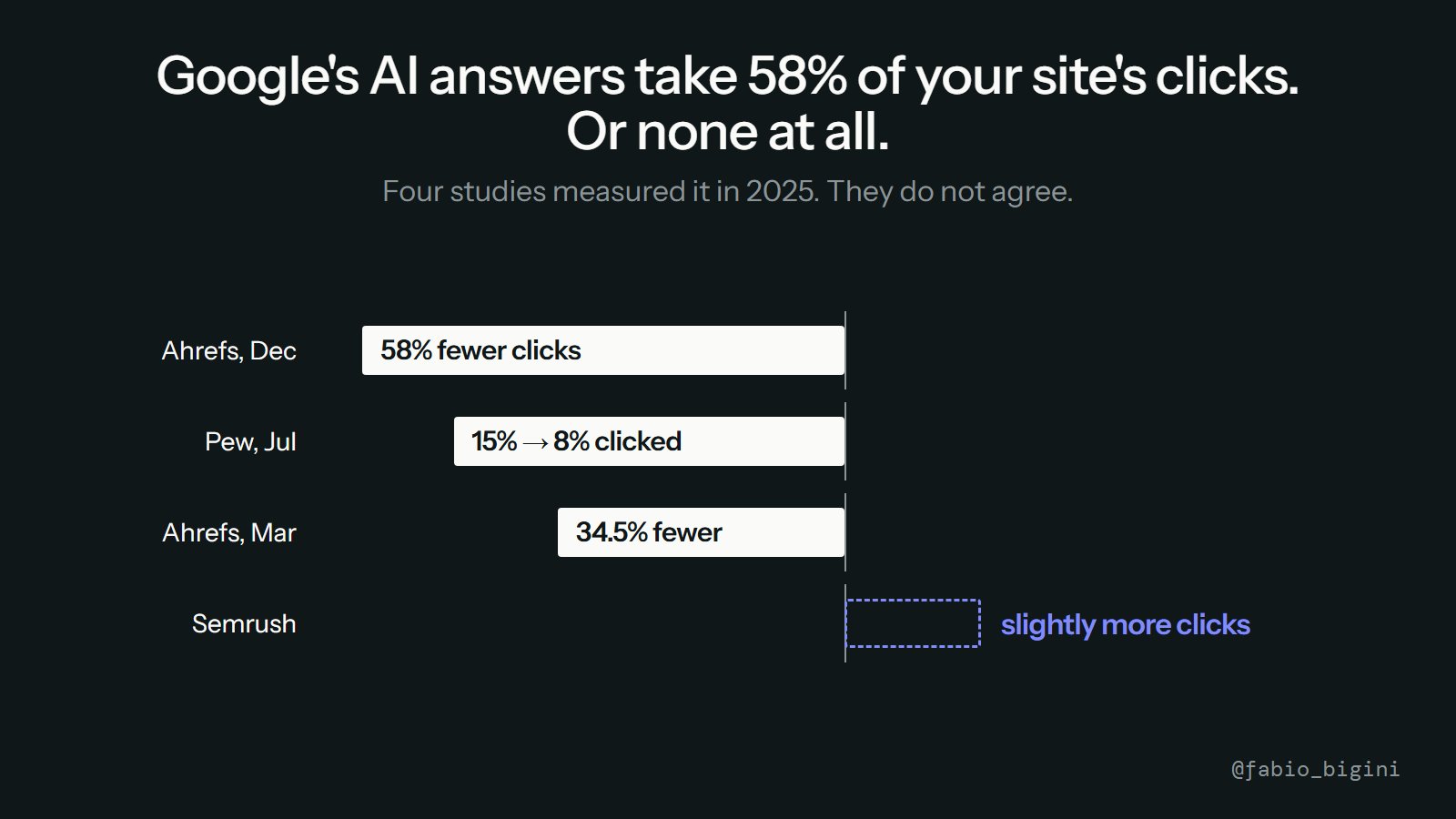
If you run a website, you have probably seen one number quoted for what Google's AI answers do to your traffic. The trouble is that four large studies measured it in 2025, and they disagree. One of them finds the opposite sign.
Here is what each one actually measured, so you can decide what to believe.
The four datasets
| Study | Finding | Measured on |
|---|---|---|
| Ahrefs, December 2025 | 58% lower click-through at position 1 | 300,000 keywords, Google Search Console data |
| Pew Research Center, July 2025 | click rate falls from 15% to 8% | 900 people, 68,879 real searches |
| Ahrefs, March 2025 | 34.5% lower click-through at position 1 | 300,000 keywords |
| Semrush, 2025 | slightly more clicks, not fewer | 10M+ keywords |
Sources: Pew, Ahrefs, Semrush.
Why they disagree
They are not measuring the same thing, and that explains most of the gap.
Pew watched people. It installed a browsing tracker on 900 US adults for the month of March 2025 and recorded what they did on 68,879 Google searches. When an AI summary appeared, the share of visits with any click on a link fell from 15% to 8%. Clicking a source inside the summary itself happened 1% of the time. This is the only one of the four that observed real behaviour rather than aggregate click data, and the only one that counts any click, not just clicks on the top result.
Ahrefs measured the top-ranked page. Twice. In March 2025 it compared 150,000 keywords that trigger an AI Overview against 150,000 informational keywords that do not, and found the position-one page received 34.5% fewer clicks when an Overview was present. In December it re-ran the analysis on 300,000 keywords using aggregated Search Console data and found 58%. Same method, larger and more direct dataset, bigger effect. That trend is worth more than either single number.
Semrush measured the same keywords before and after. Looking at over ten million keywords and comparing the same search terms before an AI Overview appeared and after, it found people clicked slightly more, and that the zero-click rate on Overview keywords has slowly declined since January 2025. One likely reason: Overviews increasingly appear on queries that were already low-click, and the Overview itself links out.
So: one study watched people, two measured the top result, one measured before-and-after on the same terms. Different populations, different metrics, different answers.
What to do with a number nobody has settled
Three things follow, none of which require picking a winner.
The direction is settled even where the size is not. Three of four find fewer clicks, and the one that does not finds "slightly more", not a reversal. Plan for fewer visits per search, not more.
The visits that remain are worth more. Adobe Analytics, on over a trillion retail visits, finds AI-referred traffic converting 42% better than other sources in the first quarter of 2026. Fewer, better visitors is a different problem from fewer visitors. (Adobe)
Measure your own category. Every one of these studies is an average across every kind of query. Whether an AI answer takes your clicks depends on whether it names you in the answer, and that is specific to your products and your competitors. It is also the one thing you can check in half a minute: ask the assistant the question your customers ask, and see who it names.
That is what the free check on our home page does, on one question, with a live search. The screenshot is yours either way.